

Bulk PTFE Tube and Rod: The Ultimate Guide for Industrial Applications
2026-11-16
In industrial environments where corrosive chemicals, extreme temperatures, and high friction are everyday challenges, material selection can make or break your process. Bulk PTFE tube and rod offer a rare combination of chemical inertness, low friction, and wide temperature tolerance — yet many engineers still rely on generic plastics that fail prematurely. This guide cuts through the confusion, revealing what actually matters when sourcing PTFE at scale: dimensional accuracy, virgin vs. recycled resin, and hidden costs. Whether you're designing valve seats, bushings, or fluid transfer lines, the following insights — sharpened by the practical know-how of TAIFNO — will help you engineer with confidence and avoid the trial-and-error trap that plagues so many projects.
Why Bulk PTFE Tube and Rod Orders Need a Different Sourcing Strategy
Ordering PTFE tubes and rods in bulk flips the usual sourcing playbook on its head. With standard materials, you can often negotiate on price alone and accept minor variations between batches. But PTFE's performance hinges on consistent density, dimensional tolerance, and surface finish. A shipment that arrives with slightly different crystallinity or a wider inner diameter can stall an entire production line, forcing rework or rejection of finished parts.
The real shift happens around traceability and lot control. In small quantities, a mixed batch might go unnoticed. In bulk, however, even a 2% variation in raw resin source or sintering profile can translate into thousands of unusable components. That's why sourcing teams need to demand full documentation for every drum or skid, not just a certificate of conformance that gets filed away. They must ask how the material was ramped through the sintering oven, what the gel time was for the resin, and whether the same tooling was used from first article to last.
Another angle often overlooked is logistics and storage. PTFE is soft and prone to deformation under its own weight if stacked improperly. Bulk orders require climate-controlled warehousing and specialized handling to prevent ovality in tubes or bowing in rods. A supplier who excels at low-volume shipments may not have the racking systems or inspection protocols to protect a full truckload. So the sourcing strategy has to weigh the supplier's physical infrastructure as heavily as their material pricing, because damage discovered weeks after delivery erases any upfront savings.
PTFE Rod vs. Tube: Matching Form to Function in Heavy-Duty Environments
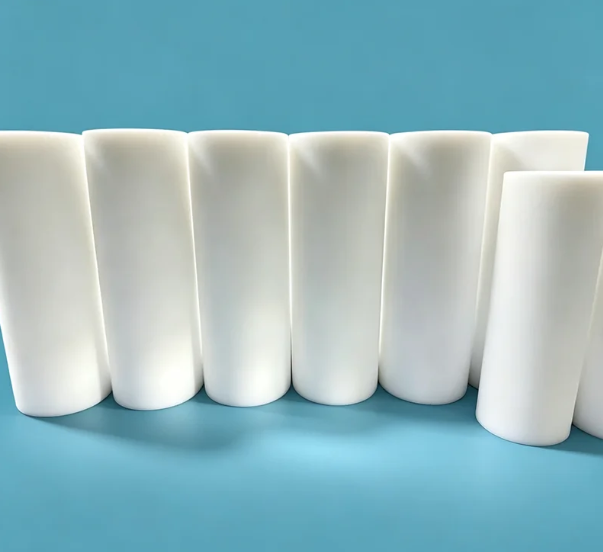
In heavy-duty industrial settings, the choice between PTFE rod and PTFE tube often hinges on how the part will actually carry load and interact with its surroundings. A solid rod delivers unmatched compressive strength and dimensional stability when you need a bearing surface, a valve seat, or a machined component that must resist deformation under sustained pressure. Its homogeneous cross-section means there are no internal voids to collapse, which proves critical when equipment cycles through extreme temperatures or aggressive chemical exposure day after day.
Tubing, by contrast, carves out a different niche. The hollow form serves double duty as both a fluid pathway and a structural insulator, allowing you to route corrosive media while keeping the outer surface electrically non-conductive. In high-vibration environments, tube’s reduced mass can actually lower inertial stress on mounting points, and the open center simplifies heat dissipation when PTFE is used as a liner inside metal housings. Many maintenance teams keep both stock on hand because a rod cut to length can replace a worn guide, while a tube section often becomes an emergency replacement for a failed chemical transfer line.
The real differentiation emerges when you look at how each form handles machining and assembly. PTFE rod offers more material to work with when turning threads, shoulders, or custom profiles, and it holds tight tolerances well because the solid cross-section resists clamping distortion. Tube, on the other hand, excels in applications where weight matters or where the center bore is already a functional requirement—think sensor probes, sampling lines, or push-pull linkages that need an insulated outer sleeve. By matching the form to the specific mechanical and chemical demands of the heavy-duty environment, engineers avoid both over-engineering with needless mass and under-specifying with a hollow part that cannot endure the compressive loads.
Temperature, Chemical, and Electrical Demands: Where Bulk PTFE Excels
In industrial settings where conditions push materials to their limits, bulk PTFE repeatedly proves its worth. For temperature, it remains stable from cryogenic lows near -200°C up to 260°C without losing structural integrity—no other common polymer offers such a broad, reliable operating window. When the heat is on and other plastics soften or degrade, PTFE simply keeps performing.
Chemical resistance is where bulk PTFE truly separates itself from the pack. It shrugs off nearly every aggressive solvent, acid, and base—including aqua regia and boiling nitric acid—without swelling, cracking, or leaching. This inertness makes it the default choice for gaskets, seals, and linings in chemical processing, where a single material failure can shut down an entire line. Unlike coated or filled alternatives, solid PTFE carries this resistance through its entire thickness, so surface wear doesn't expose a vulnerable core.
Electrically, bulk PTFE excels as a high-frequency, low-loss dielectric. Its dielectric constant stays near 2.1 across a wide frequency range, and its dissipation factor remains exceptionally low even at microwave frequencies. Combined with high dielectric strength and arc resistance, this makes it indispensable for aerospace wiring, radar systems, and high-speed connectors—applications where signal integrity and insulation reliability cannot be compromised.
Cutting, Drilling, and Finishing PTFE Stock Without Compromising Tolerance
Machining PTFE stock demands a different mindset than working with metals. The material’s softness and high thermal expansion mean that aggressive feeds or dull tools will smear the surface and blow past dimensional limits long before the part looks visibly damaged. For cutting, use razor-sharp HSS or carbide tools with generous rake angles and light depths of cut. Keep speeds moderate so heat does not build up in the cut zone, because PTFE will deform locally and then spring back, leaving a tapered or undersized feature.
Drilling presents its own headache: chips tend to wrap and pack instead of breaking cleanly. A slow spiral or parabolic flute drill with a high helix helps pull material out, but you still need a peck cycle to clear the flutes every few diameters. Back off the feed as the tool exits, and support the backside of the stock if possible. For holes with a tight tolerance, consider drilling undersize and then reaming with a dead-sharp reamer run at a low spindle speed, because PTFE will close in slightly after the tool passes.
Finishing is where most tolerance slip happens. PTFE does not cut so much as flow under pressure, so heavy sanding or aggressive filing will just push material around. Use fresh, fine-grit abrasives with very light pressure, or take a whisper cut with a honed tool to shave the final few tenths. Let the part normalize to room temperature before checking critical dimensions, and measure with low-force instruments. If you need to hold a bore or flat within a couple thousandths, plan for a brief rest period between roughing and finishing so the stock can stop moving.
Inventory Management for High-Volume PTFE: Avoiding Supply Chain Surprises
High-volume PTFE consumption often creates a false sense of security when monthly order volumes look steady. The real vulnerability sits deeper—upstream fluorspar availability, resin polymerization schedules, and extrusion-grade lot consistency can shift without warning. Teams that only track on-hand cartons and open purchase orders get caught when a single production line changes specifications or a supplier's reactor goes down for maintenance. A more useful habit is mapping every SKU back to its raw material and processing node, then setting reorder triggers that account for those hidden lead times rather than assuming standard shipping windows will hold.
Surprises rarely come from total stockouts. They come from having plenty of the wrong grade while the line starves for a specific micron size or bulk density. High-volume PTFE buyers benefit from separating inventory into run-rate items and buffer items. Run-rate inventory covers predictable demand with tight reorder points, while buffer inventory is deliberately oversized for grades that are difficult to source quickly, like certain fine-cut or modified PTFE powders. This split prevents over-investment in commodity stock that always arrives on time and under-investment in specialty stock that can vanish for weeks.
A practical control is quarterly supplier scorecarding that looks beyond on-time delivery percentage. Ask suppliers to share their own upstream inventory positions for key precursors and their scheduled maintenance windows. Then run a simple scenario check: if the largest supplier misses two consecutive shipments, how many production days remain before the line slows? That number should be visible to procurement and operations, not buried in a spreadsheet. High-volume PTFE runs smoothly when inventory policy is built around lead-time variability and supplier fragility, not just historical usage.
Case in Point: How Bulk PTFE Shapes Up in Food Processing and Semiconductor Lines
Bulk PTFE earns its keep in food processing lines where a single lingering flavor or residue can spoil an entire batch. The material's non-porous surface shrugs off sticky syrups, acidic tomato pastes, and abrasive powders without degrading, and its wide temperature tolerance means the same gasket or lining works from blast freezing to steam cleaning cycles. That kind of durability eliminates the frequent change-outs that often introduce contamination risks.
In semiconductor fabs, the stakes shift to ionic purity and particle shedding. Bulk PTFE used for chemical delivery, wet benches, and DI water systems offers extremely low extractables, so it doesn't leach metals or organics into ultrapure fluids. Its inherent lubricity also reduces friction in valve seats and pump diaphragms, cutting down on the microscopic wear particles that can ruin wafer yields.
What sets bulk PTFE apart in both arenas is the ability to machine large, seamless components from a single block. Unlike welded or sintered assemblies, these monolithic parts eliminate crevices where bacteria or process chemicals can hide, and they maintain dimensional stability under repeated thermal and pressure swings. It's a quiet workhorse material, but the performance difference shows up in fewer line stoppages and more consistent product output.
FAQ
PTFE's carbon-fluorine bonds are essentially inert to nearly all industrial chemicals, including strong acids, bases, and solvents that quickly degrade stainless steel or exotic alloys. Unlike metal, it won't leach ions or catalyze reactions, which matters in semiconductor and pharmaceutical lines. The smooth bore also reduces scale buildup, and the tubing handles continuous temperatures up to 260°C without embrittlement, so it stays reliable in both cryogenic and hot process loops.
Look beyond just diameter tolerance. Check whether the rod is virgin or reprocessed PTFE, because reprocessed material often has lower tensile strength and more internal voids that cause tool chatter. Ask for stress-relieved rod if you plan to turn thin-walled components; non-relieved stock tends to warp after material removal. Also confirm the specific gravity—virgin PTFE is around 2.15 to 2.17 g/cm³, and lower values usually mean porosity or filler inconsistencies.
PTFE tube itself has poor creep resistance under continuous pressure, so it is rarely used as a standalone hydraulic line above roughly 10 to 15 bar unless reinforced with stainless steel braid or a close-fit metal jacket. The unreinforced tube can balloon or split at fittings over time, especially with pressure spikes. For high-pressure fluid transfer, choose a braided PTFE hose or use thick-wall rod with a carefully designed compression fitting that limits cold flow.
PTFE is much softer and more prone to deformation under cutting forces, so you need sharp, high-positive-rake tools and light cuts. It also has a high thermal expansion coefficient, meaning dimensions grow noticeably during machining; let the part cool before final measurement. Unlike nylon, PTFE doesn't absorb moisture, so you won't see post-machining dimensional changes from humidity, but you will see stress relaxation if the rod wasn't annealed.
PTFE has the highest continuous service temperature of the three and better chemical resistance in extreme oxidizers. It also has the lowest friction coefficient and doesn't become brittle at cryogenic temperatures. However, PFA and FEP are melt-processable, so they offer clearer, more flexible tubing with better clarity for visual flow monitoring. If you need maximum thermal and chemical performance and can tolerate a stiffer, opaque tube, PTFE is the better pick.
One major issue is ignoring creep: PTFE cold flows under load, so a tight interference fit may relax and lose sealing force within hours at elevated temperature. Another mistake is using thin sections without a metal backup ring; the PTFE can extrude into the clearance gap. Also, over-tightening flanges on PTFE gaskets causes the material to flow outward and thin, which actually reduces seal effectiveness. Proper groove design and controlled compression are key.
Semiconductor fabrication uses bulk PTFE for chemical delivery lines and wafer handling components because it doesn't shed particles or react with aggressive etchants. Chemical processing plants rely on PTFE rod for valve seats, seals, and pump housings exposed to acids and solvents. Food and pharmaceutical lines specify PTFE tube for inert fluid transfer and FDA-compliant linings. Electrical and aerospace sectors also consume large volumes for insulation and high-temperature wire harnesses.
Conclusion
Sourcing bulk PTFE tube and rod demands a fundamentally different approach than buying small quantities. High-volume orders hinge on matching the stock form to the actual load: rods carry compressive and structural loads where rigidity matters, while tubes shine in fluid transfer, insulation, and weight-sensitive assemblies. In heavy-duty settings, the material's thermal stability from cryogenic conditions to 260°C, near-universal chemical inertness, and excellent dielectric properties often justify the upfront cost. But the real challenge comes after delivery. Machining PTFE stock without distorting tolerances requires sharp tooling, controlled feeds, and a clear understanding of the material's creep and thermal expansion. Inventory strategy also shifts—long lead times and batch-to-batch variation mean forward planning and vendor qualification matter as much as unit price.
Nowhere is this clearer than in food processing and semiconductor fabrication. In food plants, bulk PTFE rod and tube replace metal parts subject to corrosion and frequent washdown, eliminating contamination risks while standing up to aggressive cleaning agents. In semiconductor lines, ultra-high-purity PTFE components handle aggressive etchants and deionized water without leaching or particle shedding, helping maintain yield. Both environments reward buyers who treat PTFE stock not as a commodity but as a precision material where form, machining practice, and supply chain discipline all feed into the final part's performance.
Contact Us
Contact Person: Tommy Xiao
Email: [email protected]
Tel/WhatsApp: 8615651509888
Website: https://www.ptfe-factory.com