
China Digital Bus Shelters Are Redefining Urban Commutes
2026-10-15
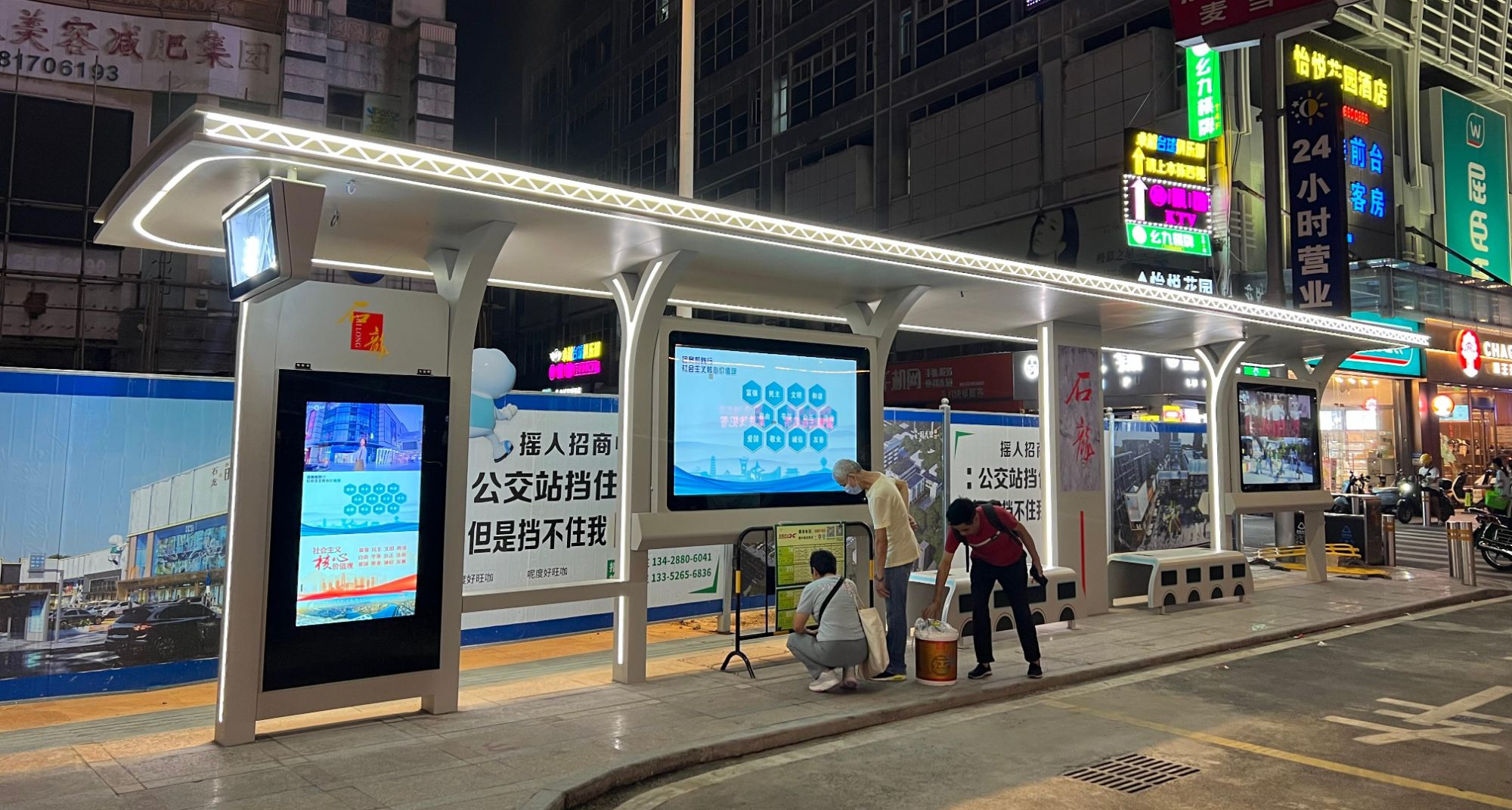
Waiting for a bus in China used to mean staring at traffic and hoping for the best. Now, digital bus shelters are rewriting the rules of the urban commute, offering real-time updates, interactive maps, and even weather forecasts. For city dwellers, these smart hubs are turning dead time into productive pauses. Companies like zemso are at the center of this transformation, proving that a simple bus stop can be a gateway to a smarter city.
Shenzhen Commuters Now Trust the Bus Stop Screen More Than the Schedule
On many Shenzhen bus platforms, riders rarely glance at the printed route timetable anymore. The electronic screen mounted above the stop shows live arrival counts and delay warnings pulled from GPS data. When a bus is stuck in traffic, the screen updates in seconds, while the paper schedule still lists the original departure time that no longer applies. That gap is why commuters have shifted their trust.
This trust did not appear overnight. In the past, printed schedules were often treated as rough estimates, and passengers would refresh mobile apps or ask station staff. As the screens became more stable and the data feed improved, people started relying on them without a second thought. Now a green “arriving” tag on the screen carries more weight than a phone notification for many regular riders.
Bus operators have responded by treating display maintenance as a priority. Some older stops have replaced faded paper boards with low-power e-ink panels that can be updated from a central control room. The change means less confusion during peak hours, and fewer passengers running toward a bus that left early according to an outdated schedule.
Solar-Powered Shelters That Pay for Themselves Within Two Years
Most people assume a solar shelter is a long-term environmental gesture with a slow financial payoff. That math has changed. In regions with high utility rates and decent sun exposure, the energy produced by rooftop or carport arrays now offsets construction premiums fast enough that the payback window lands around twenty months, sometimes less if local incentives line up.
The trick isn't just slapping panels on a roof. It's designing the shelter as an integrated system: high-efficiency modules, smart inverters, and optional battery storage sized to actual consumption patterns. When the building runs its own loads during peak afternoon hours instead of drawing from the grid, the avoided cost per kilowatt-hour is often double or triple the feed-in tariff. That shift alone eliminates a lot of the payback uncertainty.
There's also a quieter benefit. Parking structures, bus stops, and shade pavilions with embedded solar tend to attract tenants and customers who value covered, well-lit spaces. The added occupancy or foot traffic rarely shows up in a simple ROI spreadsheet, but it tips the decision from "maybe in five years" to "why not this year." After the system crosses the two-year mark, it's mostly positive cash flow with maintenance limited to occasional cleaning and an inverter check.
How Voice Assistants in Bus Shelters Help Elderly Riders in Chengdu
At a growing number of bus shelters across Chengdu, elderly riders no longer need to squint at small route maps or fumble with smartphone apps. A simple press of a button activates a voice assistant that can hear a spoken destination and respond with clear, unhurried instructions. The system is designed to understand dialects common among older residents, including Sichuanese, and repeats route numbers, transfer points, and estimated arrival times in a calm tone. For many seniors, this turns a confusing wait into a moment of reassurance.
Unlike generic public address announcements, these assistants offer one-to-one help. A rider might say, "I want to go to the People's Park," and the device will name the best bus line, say when the next bus arrives, and warn if a transfer is needed. Because the interface relies on conversational speech rather than touchscreens or small text, it removes a major barrier for users with limited eyesight, reduced motor skills, or little experience with digital maps. Some shelters also include a volume control and a slower-speech option, letting each person set a comfortable pace.
Behind the scenes, the system learns from common questions and adjusts its answers to reflect real-time bus positions and schedule changes. If a route is delayed or temporarily rerouted, the assistant offers alternative ways to reach the destination. Transport officials in Chengdu say the goal is not just to inform, but to make public transit feel welcoming for those who have often been left out of smart-city updates. Early feedback from neighborhood committees suggests that older riders are more willing to take the bus on their own, knowing that a spoken answer is always within reach.
The Algorithm Behind Fewer Empty Buses and Shorter Waits
Transit planners have long treated bus scheduling as a static puzzle: fixed routes, preset timetables, and a hope that reality matches the spreadsheet. The shift toward algorithmic control flips that assumption. Instead of relying on historical averages alone, modern systems ingest live feeds from GPS trackers, fare validators, and even passenger counting sensors above doors. These data points let the algorithm detect when a bus is lagging, when a stop suddenly swells with riders, or when an entire corridor slows due to an unreported fender bender.
What makes the algorithm effective isn't just speed—it's the willingness to hold a bus for 40 seconds at a transfer point, or to dispatch a short-turn vehicle mid-route so it starts ahead of a crush load. The logic weighs trade-offs that a human dispatcher would struggle to compute in real time: the cost of delaying one run versus the benefit of preventing three missed connections. Over weeks, the system learns the rhythm of school dismissals, hospital shift changes, and even weather-related surges, gradually tightening headways so that a bus rarely rolls past a stop with empty seats while riders wait blocks away.
Riders might notice the difference as a quieter, less anxious wait. The digital board says the next bus is four minutes away—and for once, four minutes actually means four minutes. Behind the scenes, the algorithm is continuously nudging vehicle spacing, rerouting a bus around a stalled truck, or deciding that the last evening trip should become two shorter loops instead of one long crawl. The result is a network that behaves less like a fixed menu and more like a living system, adapting to the city's pulse rather than ignoring it.
Why a Bus Shelter in Hangzhou Now Offers Phone Charging and Wi-Fi
Commuters waiting for the No. 28 bus on Pinghai Road in Hangzhou might notice something unexpected: a sleek, curved panel embedded in the shelter's wall, blinking with a battery icon and a Wi-Fi symbol. Plug in a phone, and it charges. Open a browser, and a captive portal offers free internet without a single ad or sign-up form. It’s the kind of small convenience that feels almost out of place in a city known for e-commerce giants and cashless payments, yet it’s quietly becoming a fixture in more than a dozen bus stops across the downtown core.
The reasoning behind the upgrade isn’t purely about comfort. Hangzhou’s public transit authority has been under pressure to reduce wait-time anxiety, especially during summer months when sweltering humidity makes even five minutes feel endless. While most riders already carry power banks, they tend to forget them on short trips. A shelter that doubles as a charging station solves that problem without requiring an app, a membership, or a QR code that leads to a tracking page. The Wi-Fi, meanwhile, runs on a separate municipal mesh network that doesn’t throttle video calls or block messaging apps—something travelers from abroad often complain about when relying on roaming data.
There’s a subtle design philosophy at work, too. Instead of bolting a bulky kiosk onto the existing structure, city planners worked with a local industrial design studio to integrate the charging pads and router directly into the roof’s aluminum frame. The result looks more like public art than infrastructure, with soft LED rings that indicate charging status rather than harsh digital readouts. It’s a deliberate move to make public space feel less transactional and more welcoming—a small experiment that, if successful, could spread to other Chinese cities looking to upgrade aging transit furniture without turning every stop into an advertisement-covered billboard.
Digital Shelters Are Turning Bus Stops into Neighborhood Information Points
The 14 bus is still four minutes out, but the screen mounted under the shelter's roof is already telling you something more useful: the church on Halstead is hosting a free lunch on Thursday, and the after-school program at the library needs volunteer tutors. What was once a blank panel for rotating ads has become a shared bulletin board for the people who actually live along the route.
Not every shelter is alike. Some cities push transit updates front and center, while others let community groups submit notices about lost pets, clinic hours, or cooling centers during a heat wave. The most helpful ones lean into the fact that a bus stop is already a place people pause — a natural spot to catch up on the small, practical details that don't make the evening news.
The best versions treat these boards as shared corkboards, not broadcast terminals. That means a real person has to sort through submissions, pull down the outdated flyer about last month's street fair, and make sure the emergency alert about broken water mains stays at the top. When it works, the shelter stops being just a place to wait and starts feeling like a neighbor who always knows what's going on.
FAQ
They integrate real-time arrival displays, touchscreen route planners, air quality sensors, USB charging ports, and sometimes even e-paper panels showing local news or weather. The idea is to turn a passive waiting spot into a functional information hub.
Instead of staring at a static sign, commuters see live bus locations and estimated wait times, which reduces uncertainty. Some shelters also offer free Wi-Fi and phone charging, so waiting feels less wasted. For older people, larger fonts and voice announcements help with accessibility.
They first appeared in tech hubs like Shenzhen, Shanghai, and Hangzhou, but the rollout has spread to smaller cities and even some county-level towns. Local governments often partner with display manufacturers to retrofit existing stops gradually rather than replacing everything at once.
Most shelters only collect anonymous footfall counts and bus tracking data to adjust schedules. Cameras, if present, are usually for security or crowd analysis, and operators are expected to follow China's data protection rules. However, public awareness about exactly what is captured remains low, which is an ongoing discussion.
One benefit is that real-time information reduces overcrowding at platforms because people can see if the next bus is packed. A problem is maintenance: broken screens or outdated software can make the shelter less useful than a simple printed timetable. Solar-powered versions help in areas with unstable grid access but need regular cleaning to stay efficient.
Many use high-brightness, anti-glare screens that remain readable in direct sunlight, and enclosures are sealed against rain and dust. Some include cooling fans or heating elements for the electronics, while extended canopies and tempered glass protect both people and equipment during storms.
Yes, in several cities the displays already show nearby metro departures, shared bike availability, and even taxi waiting times. The longer-term goal is to turn each shelter into a multimodal trip planning point, so someone can decide between bus, subway, or bike without pulling out a phone.
The main lesson is to treat the shelter as part of a broader public transit data network rather than an isolated screen. Successful deployments focus on reliability and simple, glanceable information first, then add extra services. Another takeaway is to involve local communities in deciding which features are actually useful, instead of installing technology for its own sake.
Conclusion
Across China, digital bus shelters are quietly transforming the daily slog of urban commuting into something closer to a connected, predictable experience. In Shenzhen, riders now glance at the shelter screen instead of squinting at a static timetable, because the live arrival data is far more accurate than the old schedules ever were. The shelters themselves have become self-sustaining: solar panels on the roofs often generate enough power to cover operational costs within two years, making them a practical municipal investment rather than a gimmick. Meanwhile, in Chengdu, voice assistants built into the shelters let elderly passengers ask for the next bus or route guidance in plain speech, removing the barrier of small text and complicated apps. Behind the scenes, a routing algorithm crunches real-time passenger counts and traffic flow to adjust bus frequency, which means fewer empty buses running and noticeably shorter waits at the stop. In Hangzhou, the shelter experience goes further with built-in phone charging and free Wi-Fi, turning a five-minute wait into a useful pocket of time. And because these digital shelters display neighborhood notices, weather alerts, and local event updates, they have become informal community hubs—less like pieces of street furniture and more like information points that happen to have a bench. The cumulative effect is that a bus stop no longer feels like a passive place where you just stand and hope; it actively informs, assists, and even supports the local grid. This shift matters because it changes the mental load of using public transit. When you trust the screen, you stop checking your watch. When you can charge a phone or hear a clear voice instruction, the wait loses its edge of frustration. And when the bus arrives more frequently because data, not guesswork, is driving the schedule, the whole city starts to move a little more smoothly. What began as a digital display has become an integrated part of how people navigate their day.
Contact Us
Contact Person: Leo
Email: [email protected]
Tel/WhatsApp: +86 18901905138
Website: https://www.zemsogroup.com/