

Cooling Mattress Topper Factory Essentials for Retail Buyers
2026-10-25
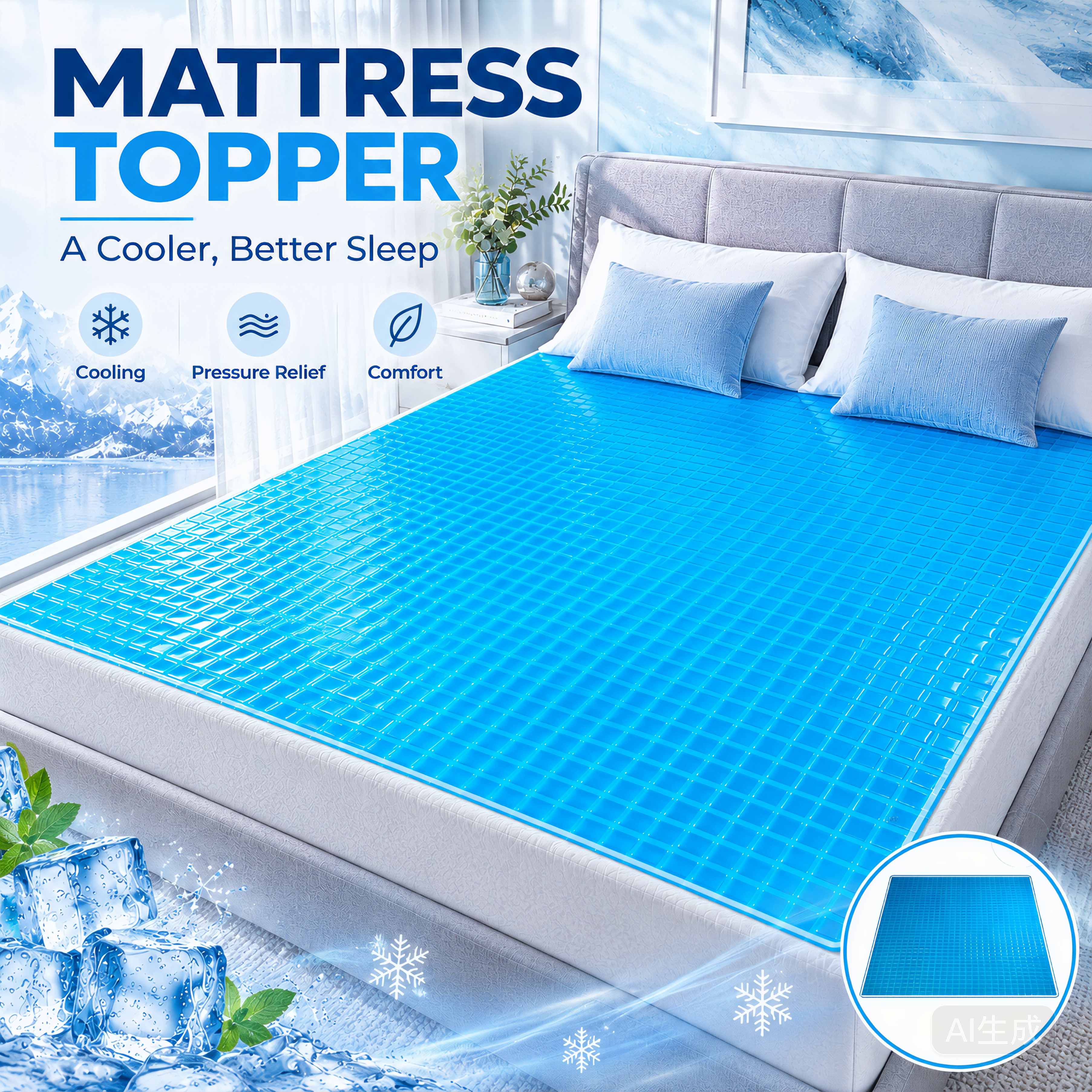
You've seen the trends: cooling mattress toppers are flying off shelves. But as a retail buyer, you know the real challenge isn't the demand—it's the factory. Not all suppliers get the gel distribution or edge support right, and a single bad batch can ruin your season. That's why we're breaking down the essentials, with insights from Kunbao, a factory that actually sweats the details.
The Real Cost Drivers Behind Cooling Mattress Toppers
The price of a cooling mattress topper rarely comes down to a single material. At the low end, manufacturers simply add a handful of gel beads to standard polyurethane foam, which does little beyond creating a temporary cool-to-the-touch feel. Genuine cooling performance, by contrast, depends on engineered inputs—phase-change materials (PCMs) that absorb and release heat around body temperature, open-cell foams that allow air to move through the core, and thermally conductive fillers like copper or graphite. These raw materials cost several times more than commodity foam, and sourcing PCM microcapsules with consistent thermal properties adds another layer of expense.
Production complexity is the second major driver. A conventional memory foam topper can be poured, cut, and boxed in a relatively simple flow. Cooling toppers often require multi-layer lamination, precision perforation or convoluted surface patterns to increase airflow, and specialized molds that prevent PCM leakage during foaming. Scrap rates rise when phase-change additives interfere with foam cell structure, so factories must run slower lines and perform more batch testing. Certifications like CertiPUR-US or OEKO-TEX also involve lab fees and ongoing audits, which get folded into the final sticker price.
Finally, durability expectations quietly push costs upward. Cheap cooling toppers degrade quickly because the gel layer separates or the open-cell foam loses resilience, forcing frequent replacements. Brands that want to avoid returns and warranty claims must use higher-density base foams, reinforced edge support, and covers with genuine cooling yarns rather than marketing-only fabric. These choices reduce long-term complaints but increase per-unit costs substantially—meaning the real price difference between a mediocre and a genuinely cooling topper often shows up months later, not on day one.
How Factory Floor Conditions Affect Cooling Performance
The air drifting across a factory floor is rarely clean or consistent. Dust from cutting operations, oil mist from machining, and even the humidity from a nearby wash bay all end up cycling through cooling units. When those particles settle on condenser fins or clog intake filters, heat exchange drops quickly—often before anyone notices a rise in internal temperatures. A unit that was sized perfectly on paper can underperform by twenty percent simply because its airflow path has become a patchwork of grime.
Floor layout plays a quieter but equally stubborn role. Place a cooling unit next to a bank of injection molding machines, and it will constantly pull in air that is already carrying waste heat. That forces the compressor to run longer cycles, pushing energy costs up while cooling capacity sags. Even the building’s own structure gets involved: low ceilings trap hot air near roof-mounted units, while open dock doors let humid outside air pour in during summer months. These are not dramatic failures, but slow, persistent drains on performance.
What matters most is that factory conditions change constantly—new machines arrive, production shifts move, and seasonal weather alters the baseline. A cooling system that coped fine in March can struggle by July without any mechanical fault. Regular visual checks of coils and filters help, but so does simply walking the floor to see where heat is being generated and where air actually moves. The best cooling strategy is not a static installation; it is an ongoing adjustment to the reality of the factory around it.
What Smart Retail Buyers Ask Before Placing a First Order
Smart retail buyers don't just look at the product sample; they ask about lead time consistency, minimum order quantities, packaging options, and whether the supplier has backup production capacity. They want to know how you handle quality control at scale, not just in the one sample you sent. Another question that often comes up: "What happens if something goes wrong with a shipment?" That covers defect rates, replacement policies, and communication turnaround. Buyers also care about compliance documents—testing reports, certifications, factory audit results—because no one wants to get stuck with inventory they can't legally sell. If you can answer these clearly before they ask, you'll already stand out from most suppliers.
Beyond the basics, smart buyers probe your flexibility. Can you handle a smaller trial order without jacking up the unit price? Will you hold inventory for a rolling schedule, or are you strictly make-to-order? They might also ask about your payment terms and whether you're open to third-party inspection. These aren't red flags; they're signs of a buyer who has been burned before and wants to avoid repeating mistakes. The more specific and calm your answers, the more trust you build.
Finally, they'll test your understanding of their market. A buyer for a boutique chain has different needs than one stocking big-box shelves—different price points, different packaging, different lead time expectations. If you're asking smart questions back (Who's the end customer? What's the sell-through target? What are the seasonal deadlines?), you signal that you're a partner, not just a vendor. That's exactly the impression you want to leave before a first order.
Cooling Technologies That Survive Multiple Wash Cycles
Most cooling fabrics lose their edge after a single trip through the washing machine, but the ones worth your money hold up cycle after cycle. The key lies in how the cooling technology is embedded—not as a surface coating that rubs off, but woven directly into the yarn or bonded at a molecular level. Look for phase-change materials or xylitol-based finishes that are designed to withstand agitation, detergent, and high spin speeds without degrading. A good test: after five washes, the fabric should still feel noticeably cool against your skin, not just slightly damp. If the brand doesn't mention wash durability, assume the effect fades fast.
Another overlooked factor is water temperature and drying method. Even durable cooling tech can be compromised by hot water or harsh fabric softeners, which leave residue that blocks the cooling channels. Stick to cold or warm cycles, skip the softener, and air dry when possible—heat from a dryer can break down microencapsulated cooling agents. Some newer garments use knit structures that create permanent airflow channels, so they keep you cool mechanically rather than chemically, and those tend to survive dozens of washes with zero loss in performance. That's the real benchmark: not just surviving, but performing the same on wash ten as on day one.
Negotiating Minimums Without Sacrificing Quality
Suppliers rarely budge on minimums if you simply ask for a lower number. The trick is to reframe the conversation around total value instead of per-unit cost. Ask what drives their minimum: setup time, material sourcing, or scheduling. Once you know the real constraint, you can propose a trial order that covers their fixed costs while keeping your risk low.
Another angle is to trade flexibility elsewhere. Offer a slightly longer lead time or agree to a rolling delivery schedule that lets the supplier batch your order with others. In many cases, they would rather accept a smaller first run from a reliable buyer than lose the relationship over a number. Just make sure any adjusted minimum is tied to a written quality standard, so the smaller batch doesn't become an excuse for shortcuts.
Spotting Red Flags in Factory Samples
When you first pick up a factory sample, let your hands do a slow pass over the seams and edges. A well-made piece won't have stray threads, uneven stitching, or rough spots where panels meet. Press the material between your fingers—if it feels thinner, stiffer, or slicker than the approved swatch, that's a sign the factory may have swapped suppliers. Compare the sample side by side with your reference: differences in grain, drape, or weight rarely show up in photos but are obvious in person.
Color is one of the easiest places for factories to cut corners, and one of the most common reasons a sample gets rejected. Check the sample under at least two light sources—natural daylight and the kind of cool white LED used in most retail spaces. A fabric that matches under warm showroom bulbs can shift noticeably in daylight. Also measure critical dimensions rather than eyeballing them. A half-inch difference in sleeve length or pocket placement might not jump out at first glance, but it will affect fit and proportion across sizes.
Don't skip the hardware and small details. Zippers should run smoothly without catching, buttons should be securely anchored, and any printed logo or label should be crisp, not blurry or off-register. Smell the sample too—a strong chemical odor often means finishing agents haven't been properly cured or aired out. And if you're checking multiple pieces from the same run, watch for inconsistency: one perfectly sewn sample next to a sloppy one tells you more about the production line than either piece does on its own.
FAQ
Start with the foam or fiber layer, not the cover. Cheaper factories often hide low-density foam under a fancy cool-touch fabric, and that's where heat gets trapped. Ask for cut samples from the actual production line, not showroom pieces.
Phase-change materials and gel-infused memory foam tend to retain their cooling feel longer than simple moisture-wicking tops. But the real test is seeing how the topper performs after five or six washes, because some coatings wash out quickly.
Many factories quote 300 to 500 units per size as a starting point, but that number is often flexible if you accept their standard fabrics and colors. Custom density or edge support can push the minimum higher, sometimes to 800 or more.
Watch for inconsistent gel distribution, weak corner straps, and a chemical smell that doesn't fade within a few days. Factories can easily make one perfect sample, but batch production reveals whether they control mixing and curing properly.
Yes, but only if their cutting and packaging lines are set up for mixed SKUs. You'll want to confirm they keep at least two weeks of raw material buffer, otherwise custom sizes can add 10 to 14 days to the standard lead time.
Ask for third-party test results showing thermal conductivity or Q-max values, and compare them against a control fabric. A factory that can't provide this data is usually relying on marketing language rather than actual material performance.
For a queen-size topper with genuine cooling features, expect roughly $18 to $35 per unit FOB, depending on foam density and cover fabric. Prices below $12 usually mean thin foam or a basic polyester top that won't hold up.
Order one full production run split across two dates, then compare three random units from each batch for weight, thickness, and cooling touch. That reveals whether the factory can repeat its results rather than just delivering one good sample.
Conclusion
Understanding cooling mattress topper production starts with recognizing that price is shaped by far more than raw foam or gel infusions. The real cost drivers include fabric weight, specialized phase-change materials, and labor-intensive quilting processes, which can shift dramatically depending on the factory's floor conditions. Humidity and temperature control in the production area directly affect how evenly cooling gels cure and whether laminated layers bond properly, which in turn impacts performance and return rates. Smart retail buyers therefore ask about moisture barriers, clean-room protocols, and batch testing before placing a first order. They also request wash-cycle data, since many cooling technologies degrade after repeated laundering, and they want to see proof of durability for at least 20 home washes rather than relying on marketing claims.
Negotiating minimum order quantities need not mean accepting lower-grade components. Instead, successful buyers negotiate by adjusting package density or reducing color options rather than allowing thinner PCM layers or cheaper adhesives. When factory samples arrive, red flags often hide in edge stitching, off-gassing smells, or inconsistent gel distribution under direct light. A careful buyer will cut open a sample to inspect layer uniformity and ask for the exact supplier of cooling yarns. By coupling this hands-on sample audit with clear questions about floor climate control and wash-test documentation, retailers can secure a product that holds its cooling effect, meets price targets, and avoids costly quality failures after shipment.
Contact Us
Contact Person: Catherine Peng
Email: [email protected]
Tel/WhatsApp: +86-13434169510
Website: https://www.kbcoolgel.com/