

Electrical Slip Ring Ranking: Best Options for Continuous Power Transfer
2026-09-09
Few components are as overlooked—and as critical—as the electrical slip ring. When a rotating assembly needs uninterrupted power, signal, or data, the right slip ring quietly prevents costly downtime, while the wrong one fails exactly when you can least afford it. The market is crowded with options promising flawless continuous power transfer, yet real-world performance varies sharply with current, speed, and environment. That's why this ranking strips away spec-sheet noise to focus on what actually holds up. Among the names that consistently surface in demanding applications, MOFLON stands out for robust engineering and deep customization. Whether you're upgrading a wind turbine, automating a robotic joint, or specifying a rotary index table, these rankings will help you match the right slip ring to your power and signal needs—before a bad choice turns into unplanned maintenance.
Why Continuous Rotation Exposes Weak Links in Standard Power Transfer
Most rotary joints are built for occasional motion—a pan here, a tilt there. But once you demand continuous, unbroken rotation, the hidden assumptions in conventional power transfer start to fall apart. Slip rings, for instance, rely on sliding contacts that degrade far faster under constant motion than under intermittent use. The very materials chosen for standard duty cycles begin to show micro-welding, oxidation, and uneven wear, which often go unnoticed until a system stalls mid-operation.
Another weak link emerges in the form of cable management. Standard setups use service loops or limited-angle flexing, which tolerate only a fixed number of bends. Continuous rotation forces cables into repeated twisting that they were never rated for, leading to conductor fatigue, insulation cracking, and eventual signal loss or short circuits. Meanwhile, the mechanical bearings and housings designed for modest duty cycles can develop hot spots from friction, altering tolerances and accelerating failure.
Perhaps the least obvious issue is thermal drift. In intermittent operation, heat dissipates between cycles. Under constant rotation, heat builds steadily in both conductive paths and structural components, shifting resistance values and changing contact pressure. What worked reliably in a test bench scenario may behave erratically after hours of uninterrupted rotation. This is why off-the-shelf power transfer components often fail exactly when a system is pushed from occasional articulation into true 360-degree, always-on duty.
Capsule Slip Rings for Tight Spaces Where Every Millimeter Counts
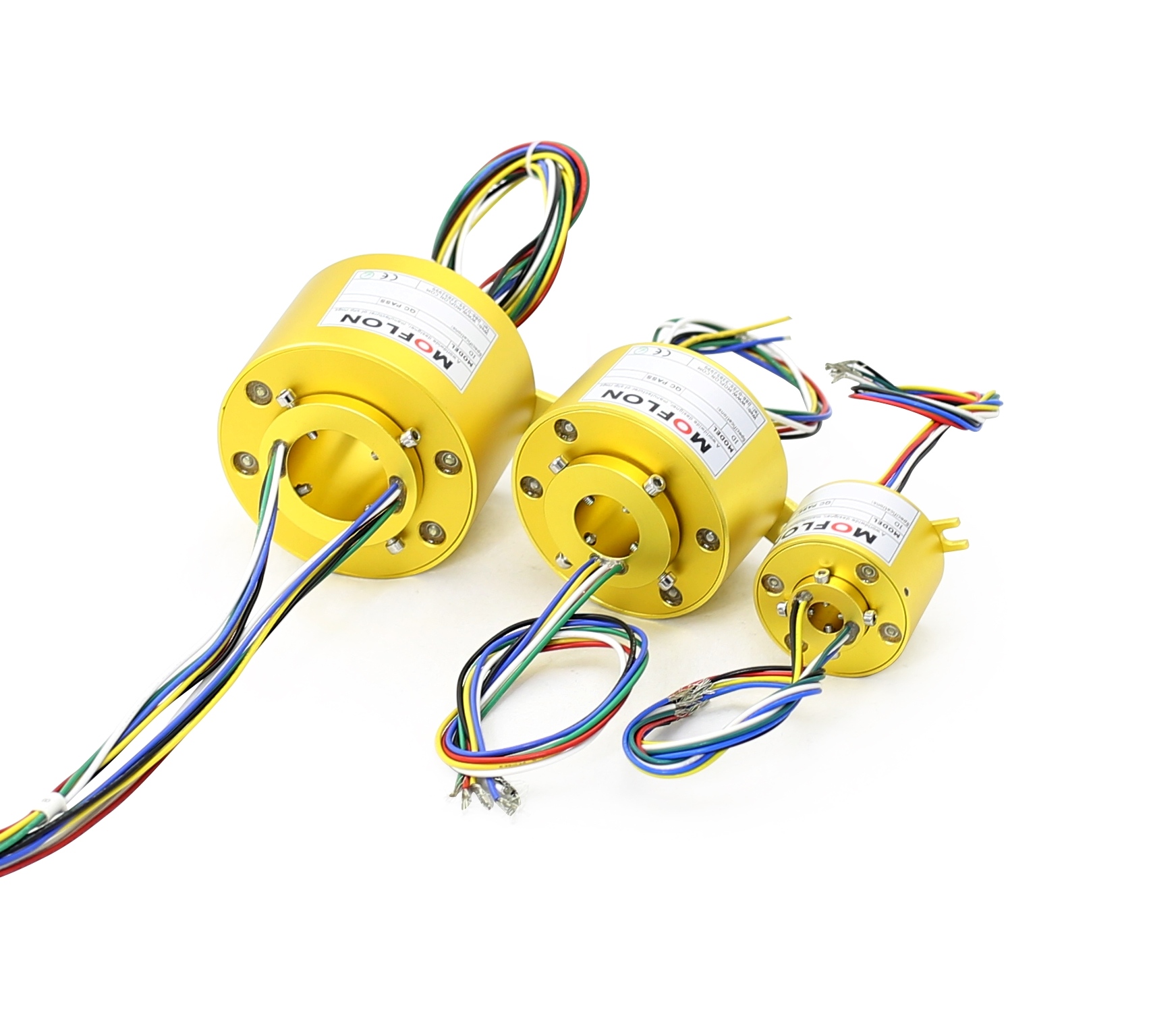
When clearance is measured in fractions of a millimeter, conventional slip rings simply won't fit. Capsule slip rings are built for exactly these situations—compact, cylindrical units that slide into spaces where larger assemblies would be impossible. Their streamlined profile hides a surprisingly capable interior, handling multiple power and signal circuits without demanding extra room. Instead of forcing you to redesign surrounding components, these rings adapt to the space you already have.
You'll find them tucked into robotic wrists, medical imaging heads, and rotary tables where every cubic centimeter is contested. The design trades bulk for intelligence—gold-on-gold contacts maintain reliable transmission even at low speeds and modest torque. What's often overlooked is how the small footprint reduces overall system inertia, which matters more than you'd think in dynamic positioning tasks. A slip ring that adds negligible weight and size lets the rest of the mechanism perform as intended, without compromise.
Maintenance is another quiet advantage. Because these units are sealed and factory-lubricated, they typically run for years without intervention—a welcome trait when access requires disassembling half a machine. And while compactness is the headline feature, it doesn't come at the cost of versatility: capsule slip rings routinely handle Ethernet, USB, and even high-frequency signals alongside power, so the tight space doesn't mean tight capabilities. For engineers who treat every millimeter as precious real estate, this is the component that earns its place by staying out of the way.
Through-Bore Options That Route Hydraulics, Pneumatics, and Cables Together
Combining hydraulic lines, pneumatic passages, and electrical cables through a single through-bore sounds straightforward until you start stacking rotary unions. The real advantage shows up in robot wrists, indexing tables, and packaging machinery where three separate feed paths would tangle or eat up vertical space. A well-designed through-bore option centralizes all three services so the tooling can rotate continuously without snagging hoses or wearing out cable carriers.
What separates a workable design from a maintenance headache is how the internal channels are isolated. Hydraulic fluid at 3,000 psi and a 24V signal bundle shouldn't share a leak path. Look for options that use individual dynamic seals per medium, a drain port between hydraulic and pneumatic sections, and a cable passage that stays static relative to the housing. This keeps cross-contamination out of the pneumatic circuit and lets the electrical side use standard connectors instead of custom splices.
On the integration side, through-bore sizing matters more than total port count. If the bore is too small for a hollow gearbox shaft or a vacuum line, you're back to external routing. Ask the supplier for a section view rather than a rendered CAD image—real drawings show whether the seals are serviceable without pulling the whole assembly. It's the kind of detail that saves half a shift during quarterly maintenance.
High-Amperage Designs That Hold Up in Wind Turbine Pitch Systems
Pitch systems in modern multi-megawatt turbines routinely push 80 to 200 amps through compact slip rings and motor leads. That kind of current turns minor impedance into real heat, so busbars, connectors, and terminal blocks are spec'd with oversized cross-sections and low-resistance plating—often silver or tin over copper. The aim is to keep hotspot temperatures below thresholds that accelerate insulation aging, not just to carry the load.
Thermal cycling is the silent killer here. Every blade pitch adjustment dumps heat into the copper, then the lull lets it cool. Over thousands of cycles, standard hardware can work loose or develop micro-fretting at contact faces. High-amperage designs counter this with Belleville washers, bolted joints that maintain clamp force, and surface treatments that resist oxidation without adding measurable resistance.
Vibration and salt-laden air add another layer of abuse. Enclosures are often sealed but not hermetically, so creepage distances are extended and conformal coatings are used on exposed current paths. Field data from offshore sites shows that combining thicker conductors, redundant grounding paths, and torqued-to-yield hardware cuts unscheduled pitch maintenance by a noticeable margin—even when nameplate ratings are pushed to their limits.
Hybrid Slip Rings Carrying Gigabit Ethernet and Fiber Without Signal Loss
Merging a fiber optic rotary joint with a slip ring stack is not just about sharing a housing. The real work lies in keeping the 1000BASE-T differential pairs isolated from brush noise while maintaining a clean optical path across the rotating interface. In wind turbine pitch controls and radar pedestals, this combination lets operators push gigabit data and single-mode fiber signals through the same rotating joint without adding bit errors or dropouts.
One of the quieter challenges is thermal expansion. As the assembly heats up during continuous rotation, copper rings and fiber collimators expand at different rates. A well-designed hybrid unit compensates for this with floating mounts and preloaded bearings, so the optical insertion loss stays under 1 dB and the Ethernet return loss remains better than -20 dB. In practice, this means the link can run for months without a CRC error spike.
Field retrofits show why the hybrid approach is gaining ground. Instead of routing separate fiber and copper paths around a rotating axis, a single unit handles both, cutting cable dressing and eliminating a common failure point at the junction box. Maintenance teams report that the integrated shielding and sealed optical chamber keep performance stable even in salt fog or high-vibration environments.
What Actually Causes Slip Ring Wear—and How to Extend Service Life
Most discussions of slip ring wear focus on friction, but the failures seen in real installations often trace back to a more subtle electro-mechanical coupling. When the brush slides across the ring, tiny arcs at the contact points create localized high temperatures, stripping material from the surface—a process called electrical erosion, which is far more destructive than pure mechanical abrasion. Vibration and misalignment also make the contact pressure fluctuate cyclically, overloading some spots while leaving others barely touched, accelerating uneven wear. Environmental dust, moisture, and corrosive gases embed themselves in the contact interface, acting as abrasive particles that gouge the ring surface.
Extending service life rarely starts with more frequent brush replacement. Instead, it begins with matching the contact pair parameters: brush pressure and surface speed must be tuned together with the current density through the contact. Too little pressure means higher contact resistance and more arcing, while too much pressure sharply increases mechanical friction. A frequently overlooked practice is to blow out the slip ring chamber with dry compressed air in dusty environments—even if the seal looks intact—because fine particles work their way into the brush path over time. For lubrication, use a conductive grease designed for slip rings and apply a thin, even film; it can noticeably cut friction and oxidation, but too much will attract dirt and turn into a grinding paste.
Here's a counterintuitive observation: lowering speed can sometimes increase wear. At very low rotational speeds, the lubricating or oxide film at the contact points doesn't have a chance to re-form, leading to direct metal-to-metal contact and adhesive wear. A better strategy is to keep the slip ring operating within its designed speed range and monitor the trend of contact resistance. If the resistance creeps upward over several weeks, wear debris is accumulating; if it fluctuates suddenly, there may be localized damage on the brush or ring. Combining this with periodic infrared temperature checks can catch hot spots early and prevent sudden failures.
FAQ
A slip ring is an electromechanical device that lets electrical signals and power pass from a stationary structure to a rotating one. It uses sliding contacts, typically metal brushes against a rotating ring, to maintain a connection without tangling wires. That is why you see them in wind turbines, rotary tables, and packaging machines.
Look at ingress protection ratings, operating temperature range, and contact material first. For harsh settings, sealed or capsule designs with gold-on-gold contacts tend to rank higher because they resist corrosion and maintain low electrical noise over millions of revolutions.
Through-bore slip rings with carbon brush contacts and multiple parallel circuits often handle high currents well. They spread the load across larger contact surfaces, reducing heat buildup. For very high currents, look for models with silver-graphite brushes and robust terminal blocks.
Contact material is a major ranking factor. Gold-on-gold offers excellent signal fidelity and low contact resistance for low-current circuits. Silver or silver alloy contacts suit higher currents but may require more maintenance. Mercury-wetted contacts provide low noise but come with environmental and safety restrictions.
Keep the unit clean and dry, avoid exceeding its rated speed and current, and check brush wear periodically. Applying a light lubricant recommended by the manufacturer can reduce friction, but over-lubrication can attract debris. Also, ensure proper alignment between rotating and stationary parts to prevent uneven wear.
Yes, many integrated slip rings now bundle power channels with Ethernet, USB, or fiber optic rotary joints. These are popular in robotics and medical imaging where space is tight and you need to avoid separate cabling. When ranking such units, pay attention to crosstalk and bandwidth limits.
Top-ranked models usually have low dynamic resistance variation, minimal electrical noise, and a proven mean time between failures under continuous rotation. They also provide consistent torque and maintain specified performance across the full speed range, not just at low RPM.
Pancake or flat slip rings are designed for low-profile installations, but they generally trade off contact surface area and can generate more heat if used for high current. They work well for modest power and signal needs where axial length is constrained, but for heavy continuous power, a drum-style through-bore is usually better.
Conclusion
When power demands continuous rotation, standard cabling inevitably twists, fatigues, and fails—often at the worst possible moment. The best slip rings for uninterrupted transfer aren't just conductive rings; they're engineered around specific constraints. Capsule designs, barely larger than a coin, solve space-starved gimbal and robotic joints where every millimeter counts. But tight spaces aren't the only battlefield. Through-bore configurations let hydraulics, pneumatics, and Ethernet share the same axis, turning a rotating assembly into a clean, serviceable hub rather than a rat's nest. And for wind turbine pitch systems, where a seized ring means a multi-ton blade locked in place, high-amperage contacts with rugged, replaceable brush blocks are non-negotiable.
Then there's the data side. Modern hybrid slip rings push gigabit Ethernet and even single-mode fiber through the same rotating interface, with shielding and impedance control that keep bit error rates near zero—no small feat at 300 rpm. But none of that matters if the ring wears out in six months. Wear comes from micro-arcing, debris, and uneven brush pressure, not just friction. Top-ranked options extend service life through gold-on-gold contacts for signal circuits, sealed housings against dust and moisture, and modular designs that let you swap a worn channel without replacing the whole unit. That combination of tailored mechanics, honest current ratings, and data transparency is what separates a pit-stop spare from a decade-long workhorse.
Contact Us
Contact Person: Xiangpin Li
Email: [email protected]
Tel/WhatsApp: 86 186 1706 8578
Website: https://www.moflon.com