
Megasonic Cleaning System Company: Choosing the Right Partner for Contamination-Free Manufacturing
2026-10-09
Particle contamination doesn't announce itself until yields drop and root-cause analysis points back to the cleaning step. That's when the real question surfaces: is your megasonic cleaning system built for your specific substrate and residue challenges, or just a generic off-the-shelf unit? Choosing the right megasonic cleaning system company can mean the difference between repeatable, contamination-free manufacturing and endless troubleshooting. Siansonic has spent years refining megasonic energy delivery for precision cleaning, but the decision goes far beyond a brand name. In this post, we'll unpack what actually separates a true partner from a parts supplier.
Why Your Current Cleaning Method Might Be Leaving Critical Particles Behind
Most standard cleaning routines rely on wiping surfaces with a cloth or disposable wipe, but this approach often just pushes microscopic debris around rather than removing it. Particles smaller than a few microns can lodge themselves in microscopic surface pores, and a simple swipe leaves them untouched. Even aggressive scrubbing with standard detergents may fail to break the electrostatic or chemical bonds that hold these contaminants in place.
The real problem isn't the effort you're putting in—it's the mismatch between the cleaning mechanism and the nature of the particles themselves. Many critical residues are hydrophobic or carry a static charge, causing them to resist being lifted by water-based cleaners. Meanwhile, tools like microfiber cloths can actually trap fine particles deep within their fibers and then redeposit them on the next pass. Without a method that specifically addresses adhesion forces, you're essentially just rearranging the dirt.
If you're working in an environment where even a single stray particle can cause defects, short circuits, or contamination failures, a visual inspection won't tell you the whole story. The particles that matter most are often invisible to the naked eye, and they remain behind long after the surface looks clean. Until you adopt a cleaning process engineered for sub-visible particle removal, you'll continue to see unexplained quality issues that trace back to the same overlooked residue.
The Megasonic Advantage: Getting Beyond Surface-Level Clean in Tight Spaces
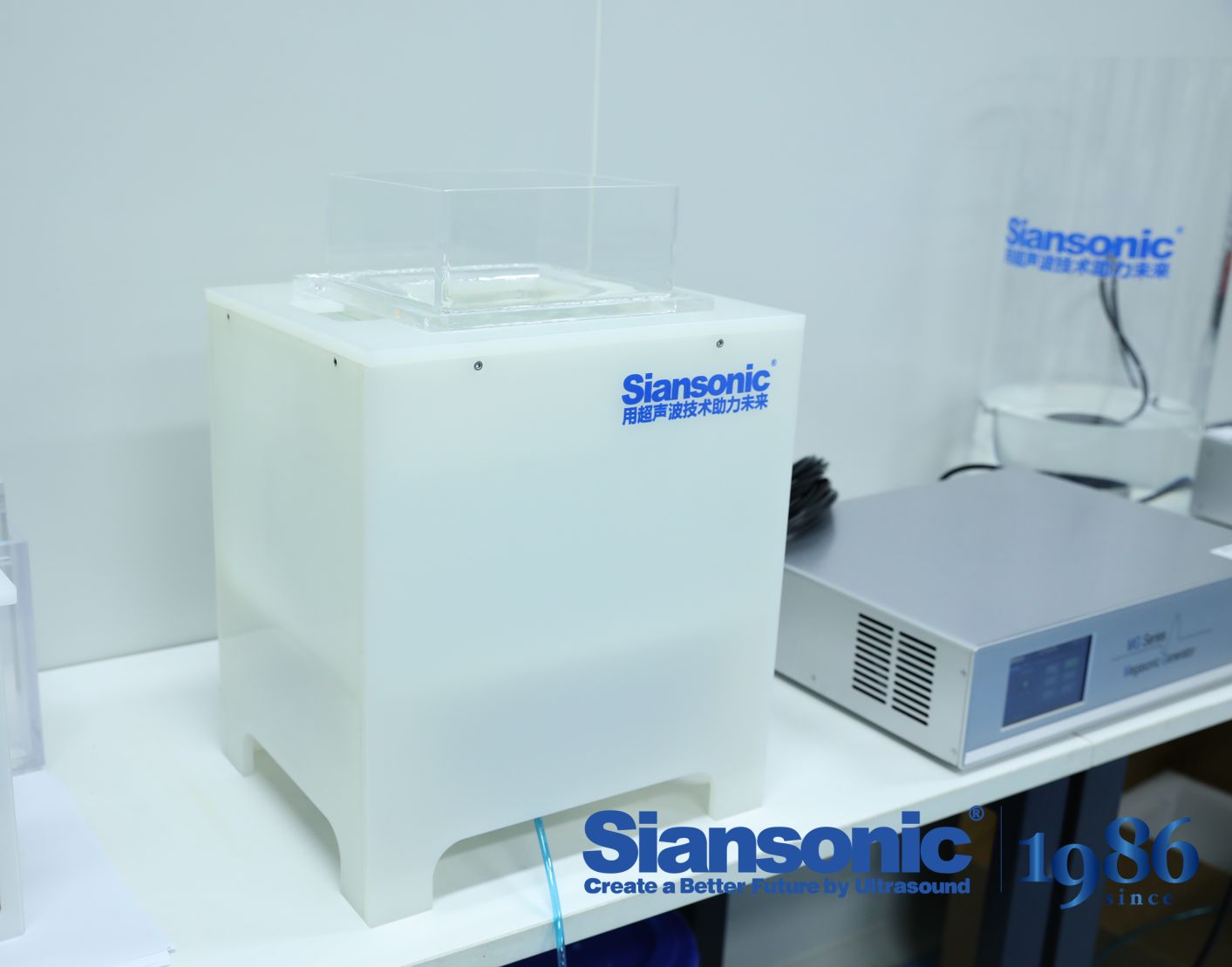
Surface-level cleaning falls short when critical residues hide in tight spaces—deep vias, narrow trenches, or underneath overhangs. The culprit is often the boundary layer: a stubborn film of liquid that clings to surfaces and blocks both mechanical and chemical action. Megasonic technology counters this by using frequencies in the megahertz range to generate fine-scale acoustic streaming and controlled cavitation. These small, energetic events pierce the boundary layer and carry cleaning chemistry into areas that ultrasonic or spray systems simply miss.
The real advantage lies in precision rather than raw power. High-frequency sound waves produce cavitation bubbles that are smaller and more uniformly distributed, so they can navigate submicron geometries without causing the erosion or damage associated with lower-frequency ultrasonic cleaning. For semiconductor wafers, implantable medical tools, and microfluidic components, this means contaminants are lifted from inside blind holes and undercuts—not just from exposed surfaces. That is the megasonic difference: a true beyond-surface-level clean where performance and reliability depend on what you cannot easily see.
Choosing a Partner, Not Just a Supplier, for Contamination Control
When contamination control starts to feel like a checklist exercise, that’s often the moment a facility outgrows its supplier relationship. A true partner brings more than product data sheets; they bring process knowledge, failure analysis, and a willingness to challenge assumptions before a deviation occurs. That shift changes the conversation from “what can you sell us?” to “how should we design this cleanroom operation together?”
The difference shows up in the details: a partner will ask about your cleaning agents, your gowning protocols, and your sampling locations without being prompted. They don’t wait for a non-conformance report to suggest improvements. Instead, they treat your contamination risks as their own, offering targeted monitoring strategies and material recommendations that fit the actual workflow rather than a generic industry template.
Long-term, choosing a partner over a supplier means you’re not just buying consumables or equipment; you’re building a responsive support system. That relationship pays off when a new product line appears, when regulations tighten, or when an unexpected excursion needs rapid root-cause investigation. At that point, the value isn’t in the invoice—it’s in the phone call you can make before the problem spreads.
Tailored Megasonic Systems: Why One Size Doesn't Fit Your Production Line
Most cleaning equipment vendors treat megasonic systems like interchangeable commodities—same frequency, same power, same tank geometry, regardless of what you're actually manufacturing. But your production line isn't running someone else's parts. A flat panel display fab handling delicate thin-film layers has almost nothing in common with a precision optics shop removing submicron polishing slurry, even if both technically use "megasonic cleaning." The idea that a single off-the-shelf unit can handle every substrate, chemistry, and throughput requirement is a costly myth.
The real divergence shows up in the details: transducer array configuration, sweep rate, degas strategy, and even the material of the tank itself. For fragile MEMS wafers, you might need a low power density with a wide frequency sweep to avoid resonance damage. For high-volume sapphire wafer processing, you need uniform cavitation across a dense cassette load without hot spots or dead zones. A standard system tuned for one will either under-clean or over-damage the other. That's why tailored megasonic design starts with your specific particle size distribution, feature aspect ratios, and cleaning chemistry—not with a catalog number.
Production engineers often discover this after the first integration headache: rework rates climb, bath life drops, or throughput stalls because the system wasn't matched to the line's actual bottleneck. A tailored megasonic approach means mapping acoustic intensity to your rack design, adjusting frequency to your contaminant adhesion strength, and even integrating filtration and dissolved gas control based on your water quality. The result isn't just cleaner parts—it's a stable, repeatable process that doesn't demand constant babysitting. When your line changes, the system should adapt with you, not the other way around.
From Prototype to Production: Scaling Megasonic Cleaning Without the Usual Headaches
Moving a megasonic cleaning process from benchtop prototype to full production often fails at the point where people assume linear scaling works. A single transducer in a small bath can produce beautifully uniform results, but doubling the tank volume or stacking multiple carriers changes the acoustic field completely. You end up with standing waves, dead zones, and cavitation hotspots that strip delicate surfaces or leave residues exactly where the inspectors look last. Instead of cranking up power, the first step is remapping the sound field with hydrophone scans or dye-erosion tests across the entire working volume.
The second headache is fluid and fixture management, which rarely gets enough attention during prototype trials. Hand-placed samples tolerate bubble entrapment and slight misalignment, but automated handling introduces repeatable flaws: pockets of air trapped under cassettes, particle recirculation from turbulent inlet flow, and chemistry drift as bath loading increases. A more reliable approach is to stage the scale-up—lock frequency, temperature, and flow rate first, then add one carrier at a time while checking for edge effects and particle counts. Sacrificial parts or glass slides with thin-film coatings can reveal non-uniform cleaning before real product is at risk.
Once the line is running, the usual production headaches shift to drift and maintenance. Transducer aging, water quality changes, and even plant floor vibration can quietly alter the acoustic output and reduce cleaning margins. Relying on offline sampling or weekly inspections lets small deviations compound into yield loss. Instead, build in continuous monitoring of power density and particle counts, with a feedback loop that adjusts generator output or flags tank conditions before the process falls out of spec. That way the system stays within its proven window without constant manual intervention.
When Even a Single Particle Can Ruin a Batch: The Case for Megasonic Precision
In semiconductor fabs, a single sub-100nm particle landing on a wafer during lithography can bridge adjacent transistor gates or block a via etch, turning a multi-million dollar lot into scrap. As geometries shrink below 3nm, the allowable particle size drops below the detection limit of many optical inspection tools, yet the yield impact is immediate. This is not a hypothetical edge case; it happens often enough that fabs maintain particle maps and root-cause teams specifically to trace a lone particle back to a single tool, cassette, or even operator gown.
Megasonic cleaning operates in a different regime than conventional ultrasonic baths. By driving transducer arrays in the 800kHz to 1MHz range, it creates gentle but highly controlled acoustic streaming and micro-cavitation that dislodges particles from trench and via bottoms without damaging fragile high-aspect-ratio structures. The precision lies not just in frequency but in power density, dissolved gas control, and nozzle-to-wafer gap tuning—each variable adjusted to match the specific film stack and defect class. A batch can still be ruined by one particle, but megasonic tools reduce that probability by orders of magnitude, turning a catastrophic random event into a statistically manageable process variable.
FAQ
Beyond the equipment itself, pay attention to their track record in your specific industry—whether they've solved similar contamination challenges for semiconductor fabs or medical device lines. A genuine partner will offer process development support, not just a machine.
Megasonic systems operate at much higher frequencies, typically near or above 1 MHz, which creates gentler but more uniform cavitation. This is critical for delicate components like MEMS or advanced packaging where conventional ultrasonic energy can cause damage.
As feature sizes shrink and tolerances tighten, even submicron particles can cause yield loss or device failure. Contamination-free manufacturing isn't a nice-to-have; it's the baseline for staying competitive in sectors like semiconductors, optics, and biotech.
The best vendors don't just sell a standalone tool—they work with your existing line, help optimize chemistry and rinse steps, and validate results against your specific cleanliness specs. If they can't speak to your substrate materials and contaminant types, keep looking.
Yes, but it depends on the system design. Look for features like multi-station processing, quick recipe changeover, and robust automation. A partner with experience in high-mix environments can tailor cycle times without sacrificing repeatability.
Focusing only on upfront cost or generic specs. Some buy a system based on a demo with idealized parts, then struggle with their real-world contamination. Ask for references with similar part geometries and contaminants, and push for a pilot run before committing.
It's crucial because cleaning performance drifts over time—transducer aging, tank contamination, and chemistry changes all affect results. A responsive partner offering preventive maintenance, calibration, and process audits helps you avoid silent yield loss.
Semiconductor and microelectronics top the list, but also precision optics, medical devices, and advanced ceramics. Anywhere that submicron particle removal or residue-free surfaces are required, a specialized partner brings more than just hardware—they bring process know-how.
Conclusion
Relying on conventional cleaning techniques often creates a false sense of security. Whether you use spray, immersion, or ultrasonic baths, submicron particles hide in micro-vias, deep trenches, and complex geometries where fluid flow stalls. These residues—often invisible to standard inspection—can cause immediate device failure or long-term reliability problems. Megasonic cleaning overcomes this by generating high-frequency acoustic waves that create controlled cavitation and acoustic streaming, reaching areas that brushes or jets simply cannot. The result is a level of cleanliness that protects yield and performance, particularly for semiconductor wafers, MEMS devices, and precision medical instruments. However, achieving this reliably at production scale is not something you can buy off the shelf—it demands a deliberate choice of technology partner.
The right megasonic cleaning system company acts as a true contamination-control partner. They assess your specific part geometry, film types, and cleanliness targets, then configure frequency, power density, and chemical compatibility accordingly. This tailored approach avoids the generic "one size fits all" trap that leads to over-cleaning damage or under-cleaning failures. Moreover, a seasoned partner helps you scale from prototype trials to full production without headaches—handling process qualification, fixture design, and integration with your existing line. When a single particle can ruin a batch worth thousands of dollars, precision and partnership are not luxuries; they are the baseline for contamination-free manufacturing.
Contact Us
Contact Person: Ivy Zhang
Email: [email protected]
Tel/WhatsApp: +86 1081502288
Website: https://www.siansonic.com/