
Top 10 Steel Grating Solutions for Durable Industrial Flooring
2026-07-06
Industrial flooring demands solutions that can withstand heavy loads, corrosive environments, and relentless wear—without compromising safety or longevity. If you’re exploring steel grating options, you’ve likely encountered a maze of materials, designs, and suppliers. The right choice can mean the difference between decades of trouble‐free performance and costly, premature failures. In this post, we’ve distilled the top 10 steel grating solutions that truly deliver on durability, drawing on insights from industry experts and real‐world installations. Along the way, you’ll discover why Sino Grating has become a go‐to partner for engineers seeking precision‐engineered, high‐resilience flooring systems. From open‐grid designs that shed debris effortlessly to heavy‐duty bar gratings that support massive forklift traffic, each solution brings something unique to the table. Ready to find the perfect fit for your toughest industrial challenges? Let’s dive in.
Choosing the Right Bearing Bar Profile for Heavy Loads
Heavy loads don't just test the strength of a grating—they demand a smart union between the bearing bar's shape and the way stress travels through the structure. A serrated flat bar might offer slip resistance, but for consistent, high-weight traffic, the profile needs to channel force efficiently. Trapezoidal or I-shaped sections, for instance, spread the load across a wider top flange while keeping weight manageable, reducing deflection under repeated cycles. The bar's height and cross-section geometry also dictate how well it resists twisting when vehicles brake or turn, a detail often overlooked until a floor starts to groan.
Material thickness alone isn't the hero here. A deep, slender ribbed profile can carry more than a stout rectangular bar of the same weight, thanks to its section modulus. This becomes critical in applications like loading docks or overhead platforms where every millimeter of depth counts against headroom clearance. Engineers often pivot to profiles with a higher moment of inertia along the load-bearing axis, which means less sag and a quieter, more stable walking or rolling surface over time.
Field conditions add another layer. Exposure to chemicals, extreme temperatures, or washing-down routines can quietly attack the bar's edges. A bullnose or fully rounded top profile, for example, sheds water and debris more readily, preserving the bar's original thickness longer. Pairing the right profile with a compatible mesh pattern ensures that point loads from pallet jacks or heavy castors are distributed to multiple bars, preventing the kind of localized bending that eventually turns into a fatigue crack. The goal isn't just holding the weight—it's doing so without accumulating hidden damage that shortens the grating's service life.
The Case for Serrated Surfaces in Wet Environments
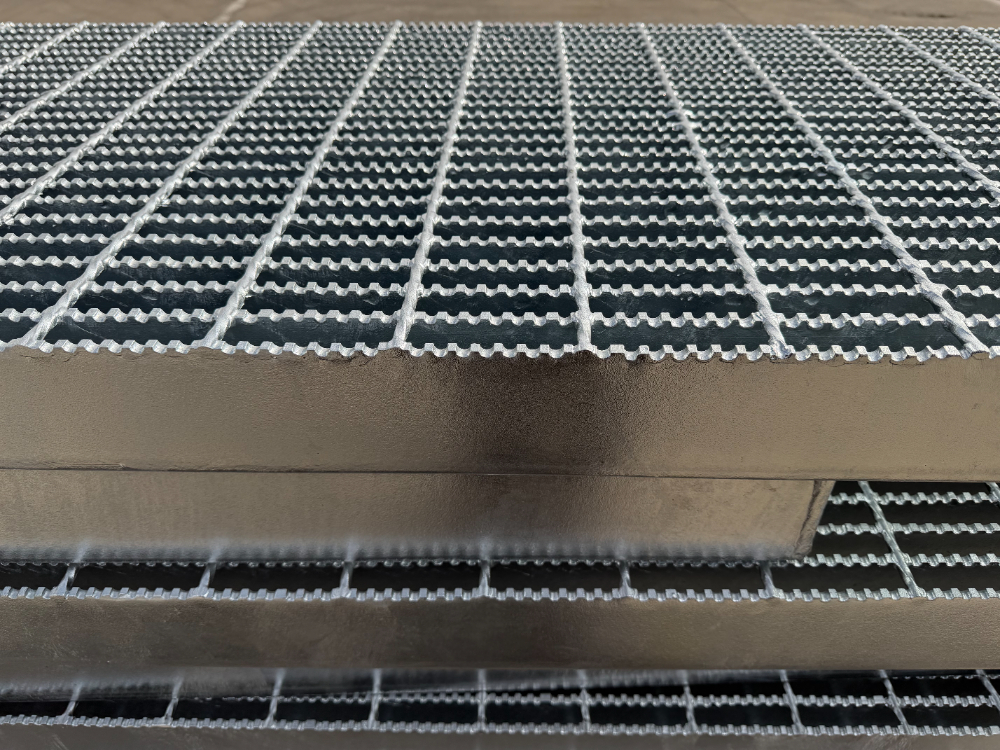
Wet conditions demand more than just friction—they require a mechanical grip that smooth surfaces simply can’t deliver. Serrated surfaces break the thin film of water that often separates foot or tire from the ground, allowing the peaks to dig in and channel away moisture. This disruption prevents hydroplaning and creates direct contact points that increase traction instantly. In environments like boat decks, industrial kitchens, or outdoor stairways, where standing water is a constant hazard, serrations transform a slick hazard into a stable foothold.
Beyond immediate safety, these textured patterns also offer surprising longevity benefits. Water tends to pool and accelerate wear on flat surfaces, but serrated profiles promote faster drainage and limit prolonged exposure. Plus, the recessed grooves trap less debris than raised treads, making maintenance simpler over time. When you factor in reduced slip-and-fall incidents and fewer surface replacements, the practical case for serrated surfaces in soggy settings writes itself—no marketing spin needed, just physics and lived experience.
Custom Fabrication Methods That Simplify Installation
Off-site pre-assembly has become a preferred approach for complex architectural metalwork. By manufacturing large, integrated modules under controlled conditions, we reduce the number of loose components that need to be handled on site. This method transforms what would typically be a multi-step lifting and alignment process into a single, pre-calibrated placement. The modules arrive with connection points pre-drilled and finishing already applied, so the field crew can position and secure each section with minimal fuss.
Adjustable bracketry and slotted fastening systems are another quiet innovation. Instead of forcing installers to achieve millimeter-level precision with fixed hardware, our designs incorporate built-in tolerance through sliding channels and indexed notches. This absorb the slight dimensional variations inherent in any building structure, eliminating the back-and-forth of field modifications. The result is a forgiving installation that still achieves a crisp, flawless final appearance.
We also employ jig-based sequencing that mirrors the actual installation logic. During fabrication, each piece is temporarily bolted to its neighbor in a mock-up bay, replicating the exact order and orientation required on site. This means components can be bundled and labeled according to build flow, so the crew never has to pause and interpret complex drawings. The system turns a potentially chaotic assembly into a visual, step-by-step process that self-checks for accuracy before anything leaves the shop floor.
Matching Grating Types to Chemical Exposure Levels
In environments where corrosive chemicals are present, the grating material must withstand not only the immediate contact but also the long-term degradation that can occur from fumes and splashes. Exposure levels vary widely, from mild occasional contact in wastewater treatment facilities to constant immersion in aggressive acids within chemical processing plants. Matching the grating type to the expected exposure level is critical for maintaining structural integrity and worker safety. For low-level exposure, where chemicals are diluted or contact is infrequent, a standard fiberglass grating with a general-purpose resin may suffice, offering decent corrosion resistance without excessive cost. However, when the operational environment involves high concentrations of strong acids, alkalis, or solvents, a premium vinyl ester or even a specialized phenolic grating becomes necessary to prevent rapid deterioration and potential failure.
Mid-range exposure scenarios, such as in electroplating shops or pulp and paper mills, often demand a balance between cost and chemical resistance. Here, grating with an isophthalic polyester resin system can handle moderate chemical attacks while remaining economical. The choice also depends on the specific chemicals present; for instance, an environment heavy in organic solvents might require a different resin formulation than one with oxidizing acids. Facility managers should map out all chemical agents and their concentrations, along with temperature factors, since elevated temperatures can accelerate chemical attack. A grating that performs well at room temperature might soften or lose strength when exposed to hot, concentrated caustic solutions. Therefore, detailed chemical resistance charts from manufacturers are essential tools for making an informed selection.
In severe exposure conditions, such as those found in chlorine production or metal pickling lines, only the most robust grating systems will endure. These settings often combine high chemical concentrations, elevated temperatures, and physical loads, pushing standard materials beyond their limits. Phenolic grating, known for its exceptional fire resistance and tolerance to strong acids and solvents, becomes a prime candidate despite its higher cost. Additionally, the design of the grating—its open area, thickness, and bearing bar spacing—can influence how chemicals pool or drain, affecting long-term performance. Regular inspections and a proactive replacement schedule based on exposure data can further extend the service life of the grating, ensuring that the selected type continues to match the real-world conditions it faces daily.
Long-Term Cost Comparisons: Steel vs. Alternative Materials
When projects kick off, initial material costs often dominate the conversation, and steel can appear pricier than alternatives like wood or reinforced concrete. But a myopic view of upfront pricing ignores how steel’s inherent strength allows for lighter foundations and longer spans, often shrinking the total bill for supporting structures. Over a 50‑year lifecycle, that early premium dissolves as you avoid the creeping expenses of warping, rotting, or pest damage that plague organic materials.
Maintenance is where steel quietly outperforms its rivals. Timber needs sealing, chemical treatments, and periodic replacement of compromised sections; concrete spalls and requires patching as rebar corrodes. Galvanized or weathering steel, by contrast, forms a protective patina and rarely needs more than an occasional wash. Factoring in the disruption costs of repeated repairs in an occupied building or a busy bridge, the savings from reducing downtime can dwarf any material premium.
Then comes the endgame: steel is the most recycled material on the planet, and its scrap value often offsets a meaningful slice of the original outlay. Alternative materials frequently head straight to landfill, carrying disposal fees and zero recouped cost. When you account for that residual value alongside a century‑plus service life, the lifetime cost equation tilts decisively in steel’s favor—not just for the balance sheet, but for the long‑term resilience of the built environment.
Maintenance Practices That Extend Service Life
Regularly scheduled inspections are the bedrock of any effective maintenance strategy. By meticulously checking critical components—bearings, seals, fasteners, and fluid levels—you can spot early signs of wear or damage long before they escalate into catastrophic failures. It's not just about following a checklist; it's about understanding the operational context. For instance, equipment exposed to harsh environments may need more frequent attention. Creating a log to track anomalies helps build a history that can predict failure patterns, allowing for timely interventions that keep machinery humming smoothly year after year.
Lubrication often doesn't get the spotlight it deserves, yet it's one of the simplest and most impactful ways to prolong asset life. Using the correct grease or oil—matched to the manufacturer's specification and operating conditions—reduces friction, dissipates heat, and prevents corrosion. What's easily overlooked is the importance of cleanliness during the lubrication process; contaminated lubricants can do more harm than good. Implementing a strict lubrication schedule and training personnel on proper techniques can dramatically cut down on premature wear. It's a small investment that pays off in fewer breakdowns and extended service intervals.
Beyond reactive fixes, predictive maintenance technologies like vibration analysis, thermography, and oil analysis are becoming indispensable. These tools allow you to peer inside complex machinery without disassembly, identifying imbalances, misalignments, or internal degradation before they cause downtime. The real trick is integrating these insights with a culture of continuous improvement—where data-driven decisions replace guesswork. When teams are empowered to act on early warnings, the result is not just longer-lasting equipment but also safer, more efficient operations that avoid the hidden costs of unplanned outages.
FAQ
Steel grating stands out because it combines high load capacity with open area for drainage and ventilation. The interlocking grid design distributes weight evenly, so you don't get localized stress points that lead to cracking. It's also inherently slip-resistant when you choose the right surface pattern, and it handles thermal expansion without warping—something solid plates struggle with in foundries or chemical plants.
For wet or corrosive environments, press-locked grating often has an edge. There are no weld beads that can trap moisture or chemicals, so the corrosion resistance is more uniform. The flush connection points also make it easier to clean, which matters in food processing or wastewater treatment. Welded grating is still strong, but if standing water is a daily reality, the smoother profile of press-locked panels tends to outlast welded ones.
It's not just about the maximum weight of the forklift—you need to factor in the dynamic load from moving, turning, and braking. A good rule of thumb is to specify grating with a concentrated load capacity that's at least 25% higher than the heaviest wheel load you expect. Also, pay attention to span deflection: too much flex over time can loosen the panels, so tighter cross-bar spacing or thicker bearing bars might be worth the upfront cost to avoid maintenance headaches later.
Absolutely. Most manufacturers can shear panels to fit non-rectangular footprints, cut around pipes or columns, and add angled trim bands for irregular edges. For uneven substrates, adjustable pedestals or custom-fabricated frames can level out the grating surface. Just provide precise field measurements—underestimating a curved cut by a quarter inch can turn a quick install into a project delay.
Often, it comes down to the coating thickness and handling during installation. Hot-dip galvanizing typically lasts decades, but if the process isn't monitored, you can get thin spots on edges or inside small openings. Field cutting without resealing the exposed steel is another culprit. Even good galvanizing fails when the coating gets chipped and nobody touches it up with zinc-rich paint. If you're in a coastal or chemical-heavy zone, upgrading to stainless or applying an epoxy topcoat over the galvanizing can buy years of extra life.
It's not just about coefficient of friction; it's about how that surface interacts with whatever is on the floor. Plain bar grating can become slick with oily residue or fine dust, while serrated edges bite into shoe soles and catch debris before it turns into a sliding hazard. However, serrated grating is harder on tires and can trap food particles, so in food plants, a smoother but still slip-resistant profile like a well-maintained Grip Strut style might be a better balance.
Shifting usually starts with improper fastening. Saddle clips or hold-down clamps that aren't torqued to spec will back out from vibration. A better approach is using self-locking, positive-holding fasteners that grip the bar itself, not just the cross-rod. Adding a thin, resilient gasket between the grating and its support frame also kills the metal-on-metal rattle. In high-speed areas, welding perimeter bars to the frame eliminates movement entirely, though that makes future panel removal trickier.
Conclusion
Selecting the right flooring for industrial settings goes beyond basic materials — it demands a careful look at load requirements, safety in slippery conditions, and resistance to harsh chemicals. For areas bearing heavy vehicle traffic or machinery, the profile of the bearing bars directly influences load distribution and structural integrity. A thicker, deeper bar can prevent bending and failure under repeated stress. Where moisture, oils, or other fluids create slip hazards, serrated grating surfaces offer much-needed traction, reducing the likelihood of workplace accidents. Chemical exposure is another critical factor; stainless steel or coated gratings can withstand corrosive agents that would quickly degrade plain carbon steel, ensuring long-term reliability. These early-stage decisions set the foundation for a floor that performs under pressure without compromising safety or durability.
Beyond material selection, practical aspects like installation ease, lifecycle costs, and ongoing maintenance shape the true value of a steel grating system. Custom fabrication, such as pre-cut panels and integrated nosing, streamlines installation and minimizes onsite labor, a benefit often overlooked. When comparing steel to alternatives like fiberglass or aluminum, the total cost of ownership over 15–20 years often favors steel due to its strength and repairability, even if the initial price is higher. A well-maintained grating floor — with routine inspections, prompt repainting of damaged coatings, and cleaning of debris from bearing bar intersections — can double its functional lifespan. These maintenance practices, though simple, prevent minor issues from escalating into structural replacements, preserving both safety and budget.
Contact Us
Contact Person: Nicholas Zhu
Email: [email protected]
Tel/WhatsApp: 18921275456
Website: https://www.sino-grate.com