

What Sets the Best UV Marble Sheets Hot Stamping Foil Manufacturer Apart in Modern Design
2026-11-16
In a market flooded with lookalike surface finishes, spotting a manufacturer that actually shapes modern design—not just follows it—takes more than a quick spec sheet. UV marble sheets and hot stamping foil have become quiet workhorses in interiors, packaging, and product detailing, yet the gap between average and exceptional is where entire aesthetics are won or lost. What separates the best? Often it comes down to material intelligence, color precision, and a willingness to push beyond standard gloss. That’s where GUMPTION enters the conversation: a name that treats foil not as an afterthought, but as a design instrument. Before diving into the technical comparisons, it’s worth understanding why the right manufacturing partner changes how designers approach texture, light, and longevity from the very first sample.
Reading the Grain Before It Exists
The phrase "reading the grain before it exists" sounds like a contradiction, but in practice it means training your eyes to see the future shape of a material before any tool touches it. Woodworkers often talk about reading grain in a finished board, yet the deeper skill lies in anticipating how that grain will emerge from a raw log, a rough-sawn plank, or even a standing tree. You learn to look past the bark and the saw marks, past the surface noise, and imagine the hidden paths of fibers waiting to be revealed. This isn't mysticism; it's a blend of observation, experience, and a kind of quiet conversation with the material's history.
To develop this sense, you start by studying failure and success together. A split log teaches you where internal tension lived; a smoothly planed surface shows where your guess matched reality. Over time, your hands begin to feel what your eyes can't yet see—a slight resistance, a change in sound, the way a chisel wants to drift. These signals become a vocabulary for the future grain, allowing you to work as if the final form were already present in the wood, simply waiting for the excess to be removed. The best carvers say the figure was always there; they just helped it appear.
This pre-reading also changes how you approach mistakes. Instead of fighting the material, you adjust the design mid-cut, treating every revealed fiber as new information. It's a constant loop of prediction and correction, much like a navigator reading a map that hasn't been drawn yet. The grain before it exists is not a fixed truth but a potential range of outcomes, and your job is to steer toward the one that honors both the wood's character and your intention.
Why Thickness Uniformity Is Non-Negotiable
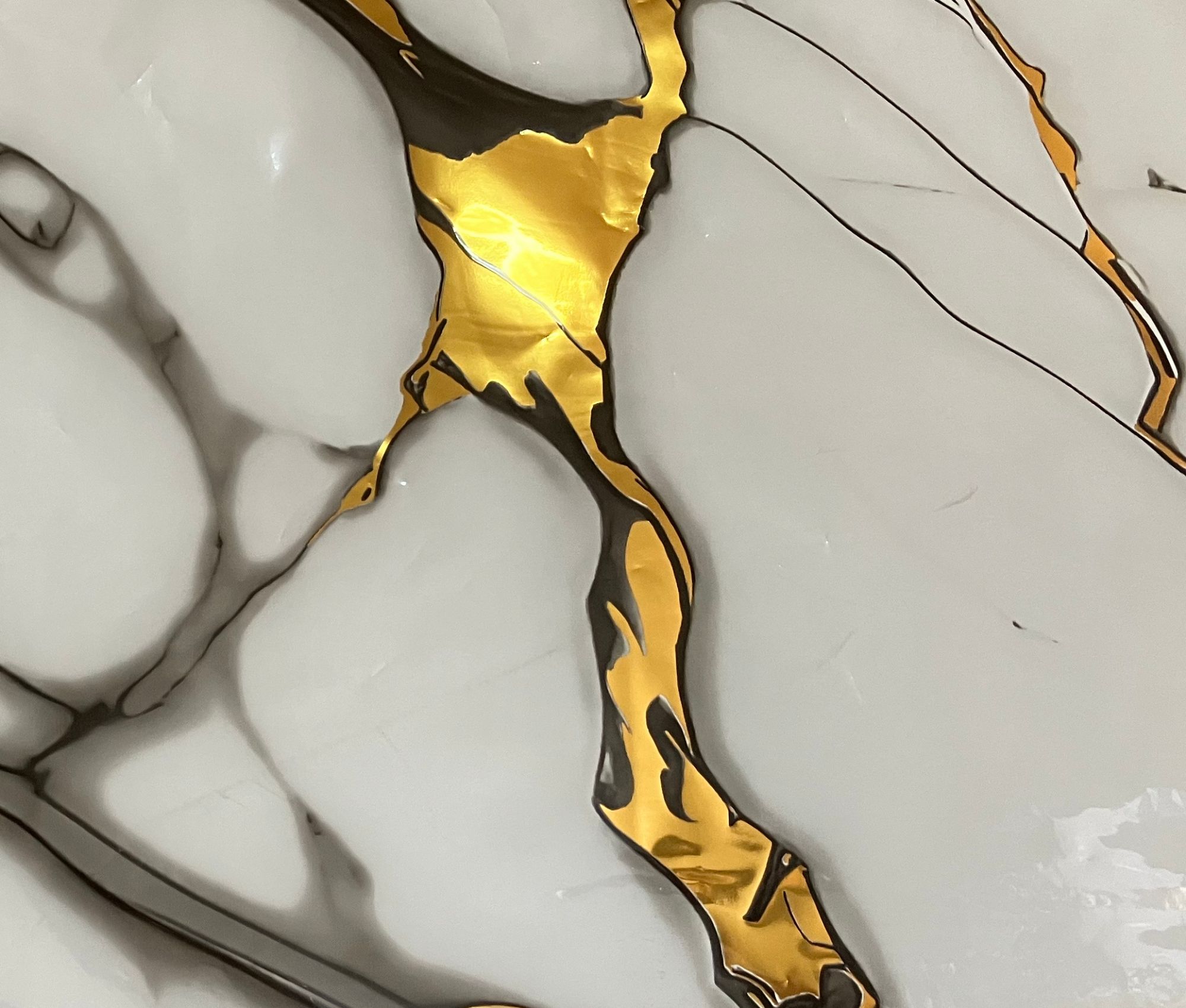
A sheet or film can look flawless under shop lighting and still carry enough thickness variation to fail in use. When one edge runs a few microns heavier than the center, the material bends, stretches, and cools unevenly. That imbalance concentrates stress at the transition zones, so cracks and delamination tend to start exactly where nobody looks until it is too late.
Downstream steps expose the problem quickly. Coating lines, laminators, and vacuum formers all assume a stable substrate. If the base gauge drifts, adhesives pool in low spots and starve the high ones, curing becomes patchy, and thermoformed parts pull out of tolerance. The result is not a minor cosmetic flaw but a functional failure that multiplies through the stack.
Uniformity is also a signal of process control. When thickness mapping stays tight across a run, it means temperatures, line speed, and die or roll gaps are behaving. When it starts to wander, operators are usually chasing a root cause rather than correcting the material. That is why gauge consistency is treated as a baseline requirement, not a nice-to-have.
The Hidden Art of Release Layer Chemistry
Most people never think about the thin boundary that lets a label peel cleanly from its backing or a molded part drop from a die without tearing. That boundary is the release layer, and its behavior is governed by an almost invisible branch of materials chemistry. At the molecular level, a good release surface isn't simply slippery; it presents a carefully arranged array of low-energy groups that reduce intimate contact with adhesives or polymers. The real art lies in controlling how much adhesion remains, because a release layer that lets go too easily can cause a label to fall off in storage, while one that holds too tightly turns peeling into a frustrating, jagged mess.
The workhorse chemistries often involve silicone or fluorinated chains, but their performance depends on far more than composition. Crosslink density, chain mobility, and the orientation of methyl or trifluoromethyl groups at the interface all shift how an adhesive wets the surface. A formulator might use a lightly crosslinked silicone network to give the chains enough freedom to bloom outward, creating a liquid-like monolayer that adhesive molecules can't penetrate. Yet the same mobility can lead to transfer of silicone onto the adhesive, a problem known as rub-off. Balancing these opposing forces requires testing under real conditions, not just static peel measurements.
Temperature and aging add another layer of unpredictability. A release coating that performs beautifully at room temperature may become brittle and grabby after a few cycles in a freezer, or it may soften and smear in a hot warehouse. Subtle interactions with the substrate, such as paper porosity or film surface energy, can also change the apparent release force. Experienced chemists learn to read the tiny shifts in peel angle or the faint haze left behind after delamination as clues to what is happening at the interface. In this hidden art, the goal is never a single perfect formula, but a robust system that behaves consistently across the messy variables of real manufacturing.
Custom Patterns Without the Usual Delays
Why settle for waiting weeks when your custom pieces can arrive before your next big moment? We've streamlined the entire creation process—from material sourcing to final stitch—so you get bespoke quality without the typical 6-8 week lead time. Whether it's a tailored blazer for an upcoming event or a one-off handbag that matches your exact sketch, our workshop runs on a lean production model that cuts out warehouse storage and middleman handoffs.
The secret lies in our local atelier network and just-in-time fabric inventory. Instead of batching orders by style or season, each request is assigned to a single skilled maker who handles your project start to finish. That means no queue bottlenecks, no lost emails between departments, and no surprise delays from overseas shipping. You approve a digital mockup on Monday, and by Friday the finished piece is on its way to your door.
Of course, speed means nothing if the details get rushed. That's why every custom order still includes a muslin fitting option and a final hand-pressed finish. The difference is that you're not waiting on anyone else's timeline—you're setting your own. Tell us your deadline, and we'll tell you exactly what's possible. No vague promises, no 'we'll try our best.' Just a clear path from idea to wearing it out the door.
How Small Batch Runs Keep Quality Honest
Small batch runs force a kind of honesty that's easy to lose when you're churning out thousands of units at once. With fewer pieces moving through the line, every flaw becomes impossible to ignore—a slightly off stitch, a misaligned label, or a finish that doesn't quite match the spec sheet. There's no statistical noise to hide behind, no 'acceptable defect rate' that lets a bad batch slip through. Each item gets looked at, handled, and judged on its own terms, which keeps the whole process grounded in what's actually leaving the shop floor.
Beyond just catching mistakes, small batches change the relationship between maker and product. When you're only producing two dozen of something, you tend to care a lot more about whether the third one is as good as the first. That kind of attention doesn't scale easily, which is exactly the point—it preserves a level of accountability that high-volume runs quietly abandon. The result isn't just fewer defects; it's a cleaner signal about what your process can really do when nobody's rushing to fill a container.
When the Finish Survives the Furniture Showroom
The showroom is where furniture goes to be admired, but the finish goes there to survive. A flawless lacquer or hand-rubbed oil isn't just a surface—it's a memory of the workshop, the dust, the patient layering. Yet under the bright lights and between the browsing crowds, that finish faces its quiet test: fingerprints, scuffs from passing bags, the slow fade of constant exposure.
Most finishes fail in the first month. They crack at the joints, dull in patches, or surrender to a water ring left by someone who set down a coffee cup without asking. The ones that endure share a stubbornness—built up in thin coats, allowed to cure long past the point of impatience, then rubbed back until they feel less like a coating and more like the wood itself, still breathing.
When a finish survives the showroom, it doesn't come with a guarantee card. It comes with a quiet confidence that you can move the piece home, let your kids climb on it, spill orange juice on a Sunday morning, and still catch yourself running your hand across the top years later, wondering how it never lost that depth. That's the finish earning its keep—not in the store, but in the living.
FAQ
A top manufacturer pairs deep material science expertise with a design-first mindset. They don't just sell foil; they study how light hits a marble vein at different angles and replicate that subtle translucency through layered UV coatings. Their technical team collaborates with furniture makers early, adjusting release properties and pigment dispersion so each sheet applies cleanly without ghosting or cracking. This level of integration is what separates a supplier from a true design partner.
Conventional foils often look flat because the printed layer sits under a simple clear coat. UV curing allows for micro-textured topcoats that follow the marble veining, creating a tactile ridge-and-valley effect. When light moves across the surface, those micro-structures scatter it differently, giving the illusion of genuine stone depth. Additionally, UV-cured resins hold ultra-fine metallic or pearlescent particles in suspension better, preventing settling and ensuring every panel matches.
Off-the-shelf patterns can date a piece or conflict with a room's specific palette. Custom foil work lets designers control the exact hue, vein density, and gloss level, effectively turning furniture into a tailored garment rather than a mass-produced item. A responsive manufacturer will run short trial batches and fine-tune the stamping temperature window, so the final finish behaves consistently across large tabletops and narrow edge banding alike.
Modern architecture often blends warm woods, cool metals, and natural stone in one space. If the foil's white is slightly blue or the gold veining drifts toward brass instead of champagne, the entire accent wall or column can feel off. Precision color matching ensures the foil aligns with specified RAL or Pantone references under multiple lighting conditions, which is critical when matching existing marble slabs or coordinating with other decorative surfaces.
Yes, when formulated correctly. The UV-cured top layer is cross-linked at a molecular level, giving it superior scratch and chemical resistance compared to solvent-based lacquers. Premium manufacturers test their foils with Taber abrasion methods and expose them to common cleaning agents like isopropyl alcohol and diluted bleach. The result is a surface that keeps its luster in hotel lobbies, retail displays, and office reception areas without requiring frequent refinishing.
Traditional foil backings were rigid, causing lifting or cracking on routed edges or embossed MDF. Modern manufacturers use flexible, heat-activated adhesive layers that conform to mild curves and even fine wood grain textures. Some have introduced stress-relief micro-patterns in the release liner, allowing the carrier to peel smoothly without tearing the transferred layer. This makes it possible to wrap cylindrical columns or radiused cabinet doors with a seamless marble look.
A reliable manufacturer can reduce solvent use by switching to UV-curable systems, which emit far fewer volatile organic compounds. They also recycle polyester carrier film offcuts and use water-based primers where possible. Quality doesn't have to suffer; in fact, UV systems often cure faster and produce harder surfaces than traditional solvent-based ones. Look for transparency about raw material sourcing and a take-back program for used foil rolls, as these indicate genuine environmental commitment rather than greenwashing.
Realistic veining isn't just about high-resolution printing. It requires studying how natural marble forms, including the branching angles, color gradients, and occasional mineral inclusions. R&D teams develop algorithms that generate non-repeating patterns across a roll, so no two sheets look identical. They also experiment with multi-layer printing, where a translucent gray vein is printed over a warm white base, then hit with a faint gold accent layer, mimicking the natural depth of Calacatta or Statuario marble. This ongoing experimentation is what keeps designs fresh and ahead of imitation products.
Conclusion
The manufacturers who truly lead in UV marble sheet hot stamping foil don't start with a pattern library—they start with the stone itself. Reading the grain before it exists means studying how light breaks across real marble, where the veins thin and swell, and then translating that rhythm into a foil that doesn't look printed but grown. This obsession extends to thickness uniformity. A deviation of even a few microns changes how the foil releases under heat, leaving ghost lines or dull patches that ruin the illusion of depth. The best suppliers treat their coating line like a calibration lab, checking cross-web profiles constantly rather than relying on batch averages. Underneath it all lies the hidden art of release layer chemistry. It's not just about making the foil come off the carrier; it's about controlling the exact moment and tension of that release so that fine veining transfers intact onto curved edges and tight radii without micro-cracking.
Custom patterns are where many manufacturers stumble, but the best have removed the usual delays by building modular engraving systems and keeping raw foil stock uncoated until a design is approved. They can move from a designer's napkin sketch to a press-ready cylinder in days, not months. Small batch runs then keep quality honest. When a factory is forced to produce 50,000 meters without a break, errors compound silently. In a 500-meter run, a technician notices a slight shift in gloss or a change in release temperature and corrects it before the next roll. Finally, the true test is the furniture showroom floor. The finish has to survive swatch books being flipped thousands of times, sunlight through glass, and the occasional coffee spill. The best UV marble foil doesn't just look expensive on day one—it keeps its depth, abrasion resistance, and color stability long after the display models have been replaced.
Contact Us
Contact Person: Hsien
Email: [email protected]
Tel/WhatsApp: +86 57387072688
Website: https://www.gsfilm.cn